01
Natural Wonder
A giant logjam helped make Jefferson a port.
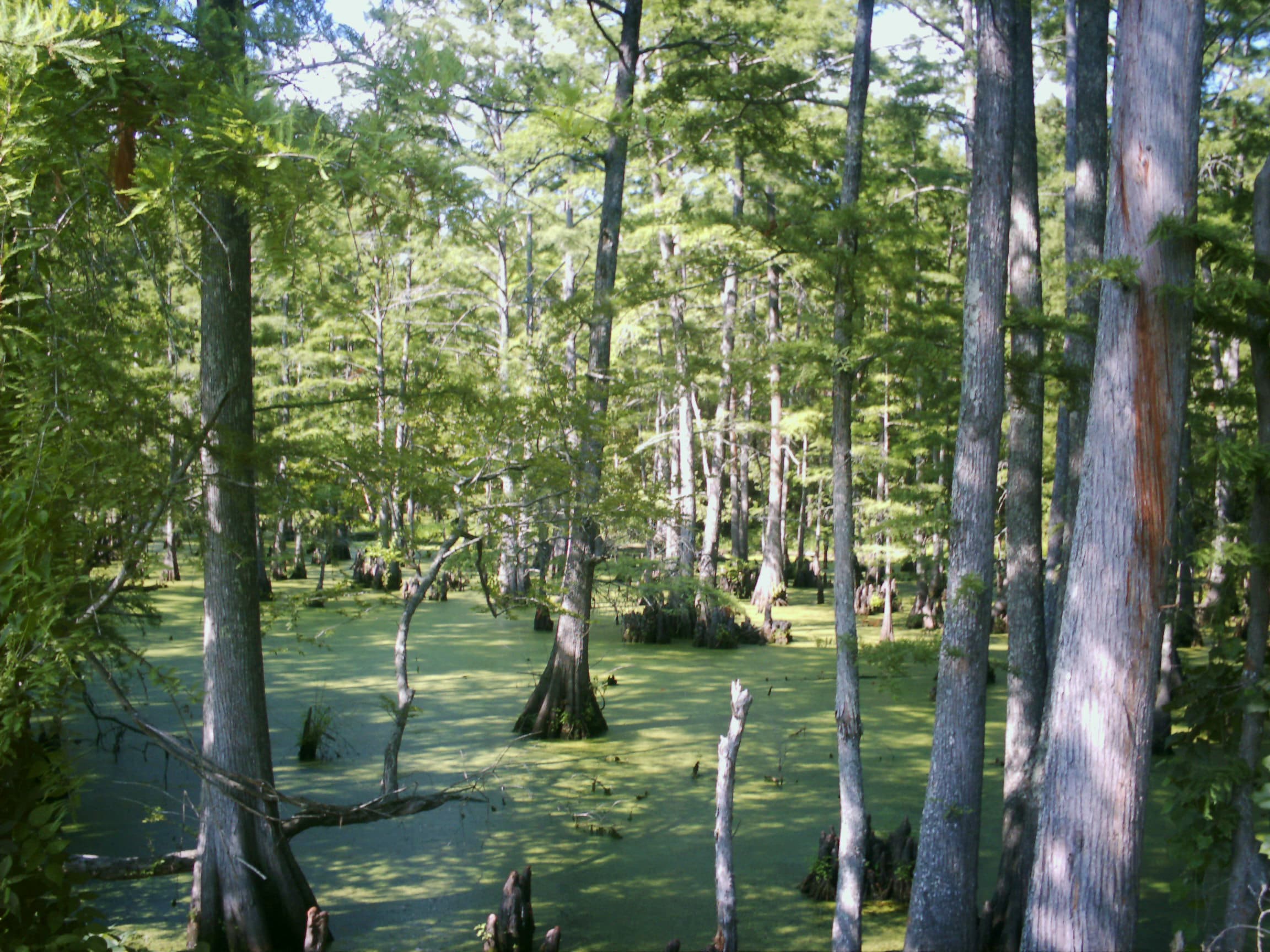
The Great Raft raised water levels through Caddo Lake and Big Cypress Bayou, making steamboat travel to Jefferson possible.
Jefferson trivia
A curated set of odd, useful, and source-backed facts about Jefferson, Texas, from steamboats and railcars to civic landmarks hiding in plain sight.
Natural Wonder
The Great Raft raised water levels through Caddo Lake and Big Cypress Bayou, making steamboat travel to Jefferson possible.
Street Detail
The bronze fountain’s water basins were arranged at three levels for different users.
Railroad Lore
The Atalanta, Gould’s ornate private railroad car, is displayed in Jefferson.
Field notes
These are written for visitor use: concise enough for a guide, grounded enough for SEO, and source-linked so the details can be checked before they become printed or social copy.
Town Layout
Two early town plats met at an angle, giving old Jefferson its distinctive V-shaped street pattern.
The Handbook of Texas credits the unusual shape to the intersection of two separate plans by Jefferson founders Allen Urquhart and Daniel Alley. It is a small planning quirk that still makes the historic district feel different on foot.
Watch the street grid bend as you move between Austin, Market, Lafayette, and the bayou.
Riverport Era
Jefferson history usually begins its steamboat chapter with the Llama, which reached town in the 1840s.
Local tourism history names the Llama, owned by William Perry, as the first steamboat to land in Jefferson. The Handbook of Texas places its arrival in late 1843 or early 1844, before regular steamboat traffic transformed the town.
Pair this with a walk down toward Big Cypress Bayou, where the old port story becomes easier to picture.
Natural Wonder
The Great Raft raised water levels through Caddo Lake and Big Cypress Bayou, making steamboat travel to Jefferson possible.
Texas Parks & Wildlife explains that riverboat commerce grew after partial clearing of the Great Raft. Jefferson prospered because backed-up waterways created a navigable route between the Red River, Caddo Lake, and Big Cypress Bayou.
This is the key trivia answer behind Jefferson’s riverport boom and later decline.
Commerce
Steamboat packets carried cotton and produce out, then returned with manufactured goods, furnishings, and city fashions.
Visit Jefferson notes that dependable navigation let packet boats travel between Jefferson and New Orleans in roughly four to five days. That connection shaped local commerce, architecture, and social life.
Look for the New Orleans feel in balconies, brick storefronts, galleries, and old hotel spaces.
Street Detail
The bronze fountain’s water basins were arranged at three levels for different users.
Texas Time Travel describes the downtown fountain as a bronze monument topped by Hebe, the Greek goddess of youth, with water pouring at three levels. The Library of Congress notes that the Sterne family gave it to the city in the early 1910s.
It is one of Jefferson’s best quick-look details: elegant, practical, and quietly funny.
Civic Life
The 1907 Jefferson Carnegie Library was built with help from Andrew Carnegie’s library program.
The library’s own history traces the project to a $7,500 Carnegie grant, paired with the city’s commitment to support operations. More than a century later, it remains a local landmark and public library.
The building sits at 310 Lafayette Street, close enough to fold into a downtown walk.
Historic Stays
The Excelsior House advertises continuous hospitality in Jefferson since 1858.
The hotel’s official history describes the Excelsior as Texas’s oldest hotel and lists a guest book that spans presidents, writers, public figures, and film history.
It is a natural trivia stop for lodging guests because the building still functions as a hotel.
Railroad Lore
The Atalanta, Gould’s ornate private railroad car, is displayed in Jefferson.
Texas Time Travel notes the irony: Jefferson rejected Gould’s railroad plan, yet the railcar associated with him now sits on display in town. The car includes Gilded Age luxuries such as staterooms, dining space, kitchen, pantry, and bathroom.
Use this as the bridge between Jefferson’s steamboat story and its railroad-era lore.
Preservation
Jefferson’s National Register historic district was listed in 1971 and spans about 107 acres.
The National Register nomination describes Jefferson as a bayou courthouse town that had once been a major Texas immigration port. The district preserves a broad downtown and residential fabric, not just a single landmark.
Give yourself time to wander side streets; much of the charm is between the obvious stops.
Architecture
The courthouse is a State Antiquities Landmark, Recorded Texas Historic Landmark, and National Register property.
The Texas Historical Commission describes a restoration that removed non-original changes while retaining or rehabilitating key historic materials, including exterior windows and interior fabric.
This is a good anchor point for explaining why Jefferson feels preserved rather than themed.
Architecture
Beyond the 107-acre Historic District, Marion County boasts 17 individually listed National Register landmarks.
Jefferson contains one of the densest collections of 19th-century Greek Revival, Italianate, and Steamboat Gothic structures in Texas. In addition to 16 Recorded Texas Historic Landmarks, two local sites carry Texas's highest preservation honor — State Antiquities Landmark (SAL) status: the 1912 Marion County Courthouse and the 1861 Stilley-Young House (The Grove).
Look for the circular bronze Texas Historical Survey medallions affixed to porch pillars and brick facades across town.
Founders
The Magnolias on East Broadway was constructed in 1867 for Victoria Kate Alley upon her marriage.
Daniel Nelson Alley, who co-founded Jefferson in the early 1840s, gifted The Magnolias (209 E. Broadway) to his daughter. The home exemplifies how Greek Revival architecture remained the preferred prestige style in East Texas riverport society well into the post-Civil War era.
The Magnolias is an active vacation rental and a featured centerpiece during the annual Historic Jefferson Pilgrimage.
Civil War
The 1863 Jefferson Ordnance Magazine on Big Cypress Bayou is an exceptionally rare wartime survivor.
Built in 1863 to supply Confederate forces across the Trans-Mississippi Department, this brick magazine stored powder and munitions ferried by steamboat. Today it is listed on the National Register (NRHP #95000102) and is one of only three such depot magazines remaining in Texas.
Pair a drive out to the magazine with a visit to Freeman Plantation and Oakwood Cemetery on our Plantations & Bayou route.
Odd Museums
The Museum of Measurement and Time centers on clocks, surveying, scales, barometers, and measuring devices.
Texas Time Travel notes that much of the collection comes from Johnny and Edith Ingram. It is one of those Jefferson stops that sounds niche until you realize how perfectly it fits a town built around maps, trade, clocks, and careful preservation.
Save this one for visitors who like precise instruments, old tools, and unusual collections.
Travel Angle
The same water system that made Jefferson boom also explains why so much 19th-century fabric survived.
When river navigation declined, Jefferson did not grow into a larger industrial city at the same pace as rail hubs. That economic turn helped leave behind the scale of storefronts, homes, hotels, and landmarks visitors explore today.
This is the page’s big-picture takeaway: the old port did not vanish; it became walkable history.